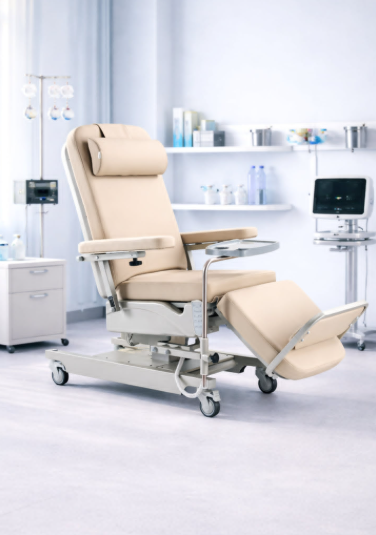
Some chairs look fine in a showroom. Then they meet a real ward. In a busy unit, dialysis chairs are in use almost every hour of the day. Patients sit for long sessions, three times a week, week after week. Staff clean them between each patient. The wheels roll, the motors lift, and the upholstery gets wiped down again and again. Within months, a weak chair starts to show the wear/tear. So the real question is plain. Will this chair still work in two years, or will you be buying another one?
Here is why this matters. A chair that fails mid-session is not a small problem. Treatment stops, and staff move the patient to another station. The unit loses a station for the day. Buy the cheapest dialysis chairs you can find, and you often pay twice, first for the chair and then for the replacement. The price on the invoice is only part of the cost.
Why High-Traffic Wards are Hard on Dialysis Chairs
A high-traffic ward never really stops. Morning shift rolls into afternoon shift, and the chairs keep moving. Think about what one chair handles in a single week. It takes dozens of patient transfers. It gets cleaned with strong disinfectant, over and over. Patients of every size shift position to get comfortable. Each part wears differently, from the frame and the wheels to the upholstery and the motors. A chair built for light use will crack somewhere first.
See also: Decorative Spray or Bottom Diffusion? Where Kasco Fountains Fit
What Makes Dialysis Chairs Last Longer?
Durability comes down to a few honest things, not the features on a brochure. The way a chair is built decides how long it lasts. Look at four areas before anything else.
The frame holds the patient and every shift in weight, so it needs welded steel rather than a light tube.
The wheels move the chair many times a day, so they have to roll smoothly and lock firmly.
The upholstery meets disinfectant every hour, so it must resist cracking and staining.
The motors lift and recline all day, so they need to run quietly without strain.
Get these four right, and most other worries tend to fade.
The Frame and Wheels Carry the Load
Start with the frame. A dialysis chair carries real weight, and it does so for years. A precision-welded steel frame, finished with powder coating, resists rust and daily knocks. Cheaper frames flex over time. Maybe not in week one, but you feel it within months. A wobble during a transfer worries any nurse, and patients notice it too.
Now look at the wheels. Lockable castor wheels let staff move a chair, then hold it dead still. That sounds small. It is not. A chair that drifts during treatment or resists when you push it slows the whole unit down. Good casters save staff a lot of strain.
Upholstery That Survives Constant Cleaning
Upholstery is where cheap chairs give themselves away. In a dialysis unit, every surface meets disinfectant several times a day. Weak material cracks at the seams. Once it cracks, fluid and germs work their way in, and the chair fails its next hygiene check.
Look for upholstery rated to resist disinfectant, along with UV, fire, and abrasion. Phthalate-free material is worth asking about, too. Perhaps that sounds minor, but in a unit that is cleaned this often, the surface gets tested daily. Esthetica builds its dialysis chairs with upholstery of this kind, so the surface stays sound through repeated cleaning. A smooth, sealed surface wipes clean in seconds and keeps the ward ready for inspection.
Patient Comfort During Long Sessions
Comfort is not a luxury here. A patient may sit for four hours or more at a stretch. If the chair hurts, they shift, they complain, and the session gets harder for everyone. Smooth electric controls let staff adjust the backrest, leg rest, height, and footrest with a button. The chair moves into a reclined or seated position without disturbing the line.
There is the Trendelenburg position too, useful if a patient’s blood pressure drops during a session. Adjustable armrests give firm support and clear access for the procedure. A seat that lowers to an easy entry point makes transfers safer, which counts for older patients most of all. Comfort and safety turn out to be the same thing.
How to Judge a Chair Before You Buy
A showroom visit only tells you so much. Ask harder questions instead. What is the frame made of, and how is it joined? How are the wheels rated, and do they lock on every side? What has the upholstery been tested against? Can the motors handle all-day use? Ask for the real specifications, not a sales line.
Here is one more point, and people forget it often. Ask who you call when something needs attention, and how quickly parts arrive. A chair is only as good as the support standing behind it. Esthetica has built medical furniture in India since 2011 and ships worldwide, which adds some weight to those answers.
For a high-traffic ward, the aim is simple. You want chairs that keep working, clean up fast, and keep patients comfortable through every session. Spend once on dialysis chairs built for that, and the ward runs calmer for years.
