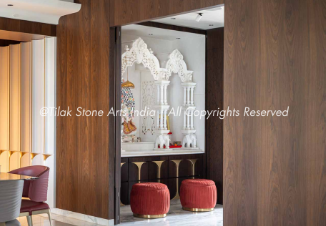
People choose the prayer corner the way they choose furniture. They look at the size, the stone’s colour, the price, and how the piece sits against a wall. They pick the carvings last, mostly because the shapes look pretty. Then, months later, a quiet question tends to turn up while you sit in front of the temple. What do these shapes actually say, and why are they there? Most carvings on a mandir for home carry an old meaning. Once you can read them, the piece stops feeling like a plain object and starts feeling like spiritually yours.
Why the Carvings on a Mandir for Home are Worth Reading
In temple tradition, almost nothing sits on the surface by accident. The carver works from a grammar that dates back many centuries, and each flower or figure conveys a specific message. When skilled hands carve a mandir for home, they preserve that grammar. A piece chosen only for its looks can lose it without anyone noticing. So you might spend years folding your hands every morning in front of symbols you cannot name.
That gap bothers people more than they expect once they spot it. Here is why it is worth closing. When you know the meaning of the carving in front of you, the prayer feels grounded and settled. The same marble shape turns from a pattern into a short message you actually understand.
See also: Pregnancy and Reproductive Health Need More Than Routine Medical Consultation
The Lotus, a Common Carving on a Mandir for Home
The lotus turns up more than any other flower on a mandir. It grows out of muddy water and still opens clean above the surface. That one habit made it a sign of purity in Hindu thought a very long time ago. Museum collections of temple art describe the lotus in the same way, as purity and as the seat of the gods. You will see Lakshmi resting on a fully open lotus, linked with wealth and good fortune. Saraswati sits on a white one, linked with knowledge.
So a lotus on your mandir is really a quiet wish. It asks for a clear mind that stays clean even when daily life around it turns messy. Some carvers add small buds beside the open bloom to hint at growth still on the way.
Om Carved into the Stone
Om sits near the top of a mandir on many designs, often right above the main niche. People treat it as the first sound, the one the universe began with. Written out, its three parts A, U, and M stand for sets of three that run through Hindu thought. They point to creation, preservation, and ending. They also point to the waking, dreaming, and deep-sleep states. A carved om turns that whole idea into something you can touch and look at. Each time you sit down to pray, the symbol above you marks the space as set apart for prayer. Maybe that is part of why people feel a small shift the moment they face it.
The Swastika and Its Four Arms
The swastika carved on a mandir is one of the oldest marks in the tradition. The Sanskrit root carries a sense of well-being, close to the idea that all is well. In Hinduism, the right-facing form stands for the sun and for good fortune at home. People often read its four arms as four different sets. Some see the four Vedas. Others see the four aims of life, or the four directions of the compass.
This is the original sacred symbol, and people have drawn it on doorways and altars for thousands of years. It sits completely apart from the way the shape was misused in twentieth-century Europe. On a mandir, it asks for protection and good fortune right at the threshold of worship.
The Kalash and Bell on a Mandir
The kalash is the rounded pot you see at the very top of a mandir and inside carved panels on its body. In the Vedas, the full pot stands for plenty and for the source of life. Topped with a coconut and mango leaves, it reads as a welcome and a wish for abundance in the home. The bell belongs to the same family of marks. Its sound calls the divine and opens the worship, while it clears your mind of the day you have just left behind. A carved bell still holds that purpose even when it never makes a sound.
Choosing Carvings That Mean Something to You
You do not need every symbol in one piece. A mandir feels stronger when its carvings match what you want it to hold. Pick a lotus if a calm, clear mind is what you are after. Choose the kalash if the home and its plenty sit at the centre of your prayers.
Fine white marble matters here. A clean, hard Vietnam white holds a sharp carving for decades, so the meaning stays readable long after the carver finishes it. Years from now, a child in your family may stand in front of the mandir and ask what the shapes mean. A mandir you choose with care gives you a real answer to give them, instead of a guess.
